
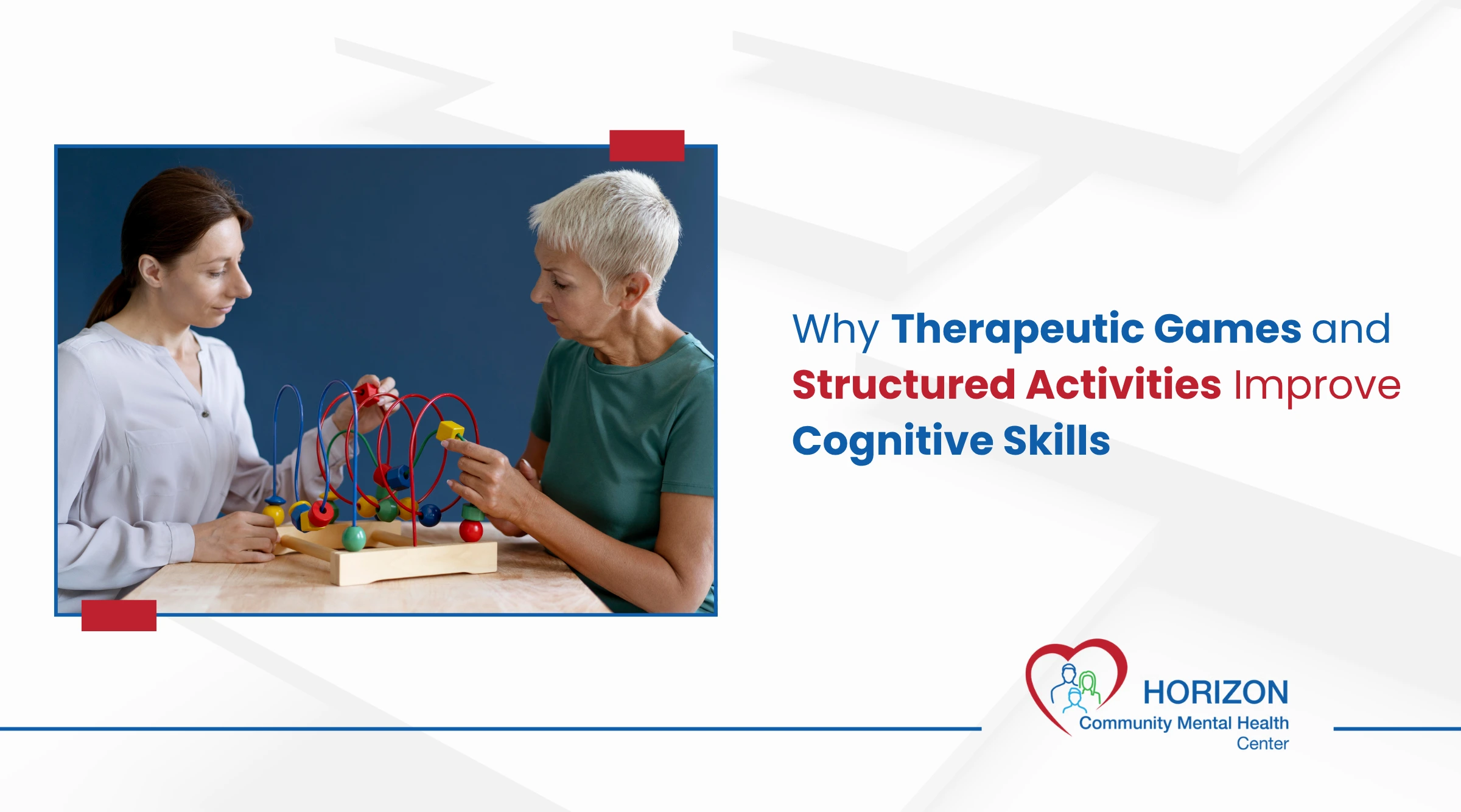
A few years into working with families in mental health care, you start noticing a pattern. The sessions that actually stick aren’t always the ones with the deepest conversation. Sometimes it’s the card game. The puzzle nobody finished. The moment someone got an answer wrong, laughed about it, and kept playing instead of going quiet.
That reaction matters more than it looks like it should. A person who’s relaxed enough to laugh off a mistake is still willing to try the next thing. Someone who’s anxious or shut down usually isn’t. Games get people into that relaxed, willing state, and once they’re there, the brain does a surprising amount of work without anyone forcing it.
Cognition Behaves Like a Muscle, Not a Fixed Trait
There’s a program called Cognitive Stimulation Therapy, CST for short, that was built originally for people with mild to moderate dementia. It’s basically structured group activity:
- Themed conversations
- Light problem solving
- Familiar topics revisited on purpose
Nothing flashy.
A randomized controlled trial tested a home version where family caregivers ran the sessions themselves. After several months, participants showed real gains in cognition and quality of life, not just mood in the moment (source). That result held up well enough that CST is now part of routine dementia care guidance in the UK, and follow-up research on adapted versions of the program keeps finding the same thing: better global cognitive function, better mood, less loneliness (source).
None of this is complicated on paper. It’s structured conversation and light mental effort, repeated on a schedule. What makes it work is that it never feels like an exam.
Games Make the Uncomfortable Parts of Therapy Easier to Tolerate
A lot of therapy work is genuinely awkward. Naming a feeling out loud. Practicing a coping skill that feels stiff and unnatural the first dozen times you try it. Sitting with a memory instead of pushing it away. Games don’t remove that discomfort, but they change how it lands.
One review described therapeutic games as tools built specifically to stay motivating while still chasing real treatment goals underneath the fun. Across the studies it looked at, people showed measurable gains in self esteem, self efficacy, problem solving, and behavior around anxiety and aggression (source). A separate pilot study on a game built for kids found something I think is the real proof point here: how well a child performed emotionally inside the game predicted how they handled emotions in real life afterward. That’s the transfer everyone in this field is actually chasing. A skill that only shows up during the game session isn’t worth much.
Structure Does More of the Work Than People Expect
It’s tempting to assume play is the active ingredient. It’s not, or at least not by itself. Structure is doing a lot of the heavy lifting. Clear rules, a defined goal, a rhythm you can predict. For someone dealing with trauma, attention problems, or cognitive decline, that predictability is often the difference between engaging and freezing up.
Board game research in schizophrenia treatment makes this pretty clear. One review of published studies found improvements in attention, working memory, processing speed, verbal and visual learning, reasoning, and social cognition among people using board games as part of care (source). What stood out in that review wasn’t the games themselves so much as how they were run: positive reinforcement, repetition, and pacing that adjusted to each person instead of forcing everyone through at the same speed.
Different Activities Pull Different Levers
Not every game trains the same skill, and matching the activity to the actual goal matters more than most people assume going in.
Fast card games and timed puzzles lean toward attention and processing speed. Sequencing and multi-step board games work on working memory. Strategy games and logic puzzles push executive function. Group storytelling or tabletop role playing builds social cognition. Digital games that walk someone through spotting a trigger and practicing a response, in a low stakes setting, target emotional regulation specifically.
A broader review of cognitive and emotional training tools backs this up, finding that action games, puzzle games, and other structured digital formats have each been used to isolate and train different pieces of cognition, from processing speed to task switching to spatial reasoning (source). No single game does everything well. Picking the wrong one for the goal is a common and fixable mistake.
Who Tends to Benefit, and Who Needs a Different Approach
Older adults working on memory and slowing decline usually respond well to this kind of structured activity. So do kids and teens building emotional regulation, and people in group therapy who need an easier entry point into a hard conversation. People managing conditions like schizophrenia, where executive function benefits from steady repetition, also tend to do well with it.
It’s a worse fit for someone in acute crisis, where structured cognitive work just isn’t the priority yet. Some people find competition stressful rather than motivating, full stop, and no amount of reframing fixes that. Others need one-on-one pacing because a group’s rhythm moves faster than they can keep up with. A clinician who knows what they’re doing adjusts the activity to the person, not the other way around.
What This Looks Like in Practice
This kind of work will never work in isolation. This is often just one part of a greater design centered upon specific objective (such as memory, attention or emotional regulation). And if an activity doesn’t yield results after a reasonable amount of time, that’s not the fault of the person performing it.
If you or your family member has started to notice some ongoing memory slips, difficulty holding attention, or are struggling with things that just came easy in the past then it might be worth having someone really look at what’s going on instead of guessing.
That is where Horizon CMHC can intercede and develop something tailored to your needs. Please contact us to set up a Consultation.