
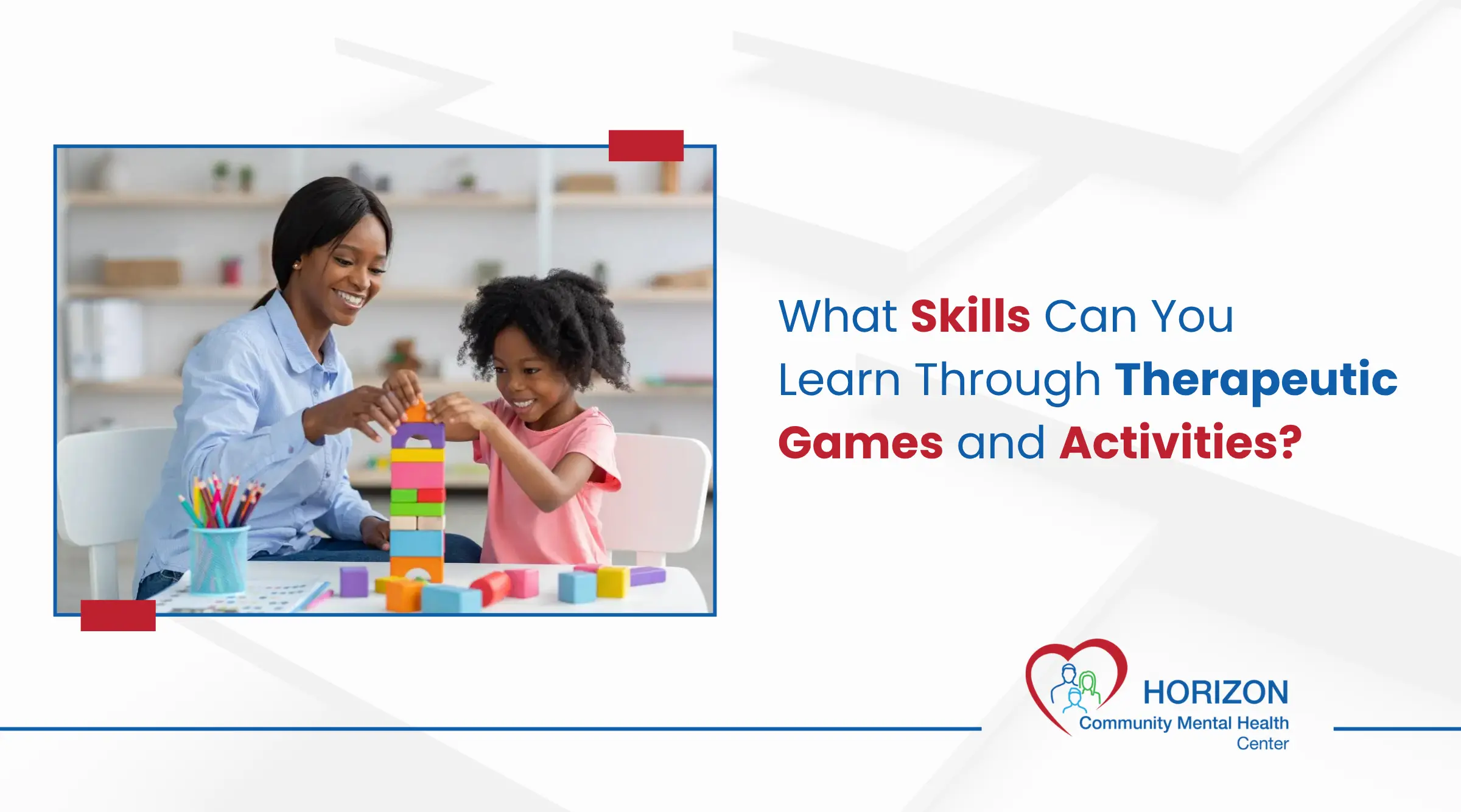
Have you ever played a game and felt better afterward? Maybe you felt calmer or happier. Maybe you felt like you could think more clearly. Games can enhance your happiness and promote valuable life skills.
At Horizon CMHC, we use therapeutic games and activities to help people grow. These games are not like regular games. They are special tools. They help people learn skills that make life better.
Let us look at some of the skills you can learn.
What Are Therapeutic Games?
Therapeutic games are special play activities guided by professionals. They can be board games, card games, or group activities. Unlike regular games, these have a clear goal.
You can also play them in a group. Unlike regular games, these have a clear goal. The games are designed to help you. They can help you feel less stressed. They can help you talk to others. They can help you solve problems.
Skills You Can Learn Through Therapeutic Games and Activities
Problem-Solving Skills
Therapeutic games help you tackle problems, big and small.
Playing requires thinking and decision-making, demonstrating the impact of your decisions. For instance, in a board game, you:
- Move your piece and choose a path
- Think about what might happen next
This is problem-solving. In therapeutic games, the problems mimic real life. You practice solving them safely, which helps you apply those skills daily.
As you practice, you feel surer of yourself. You learn that you can handle hard situations.
Communication Skills
Talking is not always easy. Some people feel shy. Some do not know what to say. Some get upset. Therapeutic games help you learn to communicate better.
You learn how to:
- Share your ideas
- Listen to others
- Talk about your feelings
- Ask for help
- Understand other people
Good communication helps you in every part of life. It benefits you in:
- School or work
- Friendships
- Family relationships
Sharing feelings can ease your burden; you’re not alone.
Teamwork and Cooperation
Some games are played alone. But therapeutic games require interaction with others. When you play with others, you learn teamwork. You learn that you are part of a group. You learn that everyone has a role. You learn to help others. You also learn to accept help.
Teamwork is vital because we all need help sometimes. These games develop essential skills such as:
- Sharing
- Taking turns
- Respecting others
- Offering support
Working as a team builds connections, reduces loneliness and fosters friendships.
Building Confidence
Trying new things can be daunting.
You might fret about making errors.
Therapeutic games provide a supportive space for exploration.
Every game you finish or solve a problem, you feel proud.
You begin to think:
- I can do this.
- I can keep trying.
- I can learn new things.
Every small success helps build confidence.
Emotional Regulation
Strong emotions like anger and sadness are common. Managing them is a vital skill.
Therapeutic games help you notice your feelings.
You learn how to:
- Stop and take a moment
- Calm your body
- Think before you react
- Make healthy choices
These skills can help you stay calm during hard times.
Social Skills
Being around other people is not always easy.
Some people feel nervous in groups.
Therapeutic games help individuals develop social skills such as:
- Taking turns
- Following rules
- Listening to others
- Showing kindness
- Handling disappointment
- Being a supportive teammate
These skills help social interactions feel easier. They also make people more comfortable in groups.
Cognitive Skills
Cognitive skills are brain skills. They help you think, remember, and pay attention. Therapeutic games can make your brain stronger.
Many games require you to remember things. You need to:
- Recall rules
- Remember what other players did
- Keep track of your strategy
This practice helps improve your memory.
Games also help you pay attention. You have to:
- Focus on the game
- Watch what is happening
- Listen carefully
Over time, your attention improves.
These cognitive skills aid learning, organization and clear thinking in school and work.
How Horizon CMHC Uses Therapeutic Games
At Horizon CMHC, we value the role of therapeutic games in our mental health services. Our team, led by Dr. Eugene Rosenman, is committed to helping others.
We choose therapeutic games and activities tailored to each client’s needs and goals.
- We do not use a generic framework.
- We get to know you and assess your specific needs.
- Then, we create a plan just for you.
If therapeutic games suit you, we’ll use them to teach essential skills.
We offer professional mental health support. Our methods are engaging. They help clients learn and grow. Clients gain practical skills for life after therapy.
Therapeutic games help people boost confidence, enhance emotions and gain key life skills.
Our center is a safe space. Share openly; we’re here to listen and support your growth at your pace.
Who Can Benefit from Therapeutic Games?
Therapeutic games are for everyone. They are beneficial for:
- Children
- Teenagers
- Adults
- People of all ages
They are useful for those who are:
- Feeling anxious or stressed
- Experiencing sadness or emotional overwhelm
- Troubled with social interactions
- Facing challenges at school, work, or in daily life
- Seeking support and a safe place to express themselves
You don’t need gaming experience to benefit from these activities. A therapist will guide you. You will learn as you go. The most important thing is that you try.
Conclusion
Therapeutic games and activities turn play into valuable learning experiences. These activities help you develop important life skills.
These skills help you in every part of life. They help you feel better. They help you do better. They help you connect with others. They help you be the best version of yourself.
If you’re struggling, you don’t have to face it alone. Horizon CMHC provides a supportive environment with personalized programs to help you feel better.
Ready to learn new skills and improve? Contact Horizon CMHC today. We’ll be with you at every step. Your journey starts now.
FAQs
Are therapeutic games a substitute for therapy?
No, they complement professional mental health support.
Are therapeutic activities just for those in therapy?
Yes, they benefit anyone by enhancing communication, teamwork, confidence and emotional skills.